




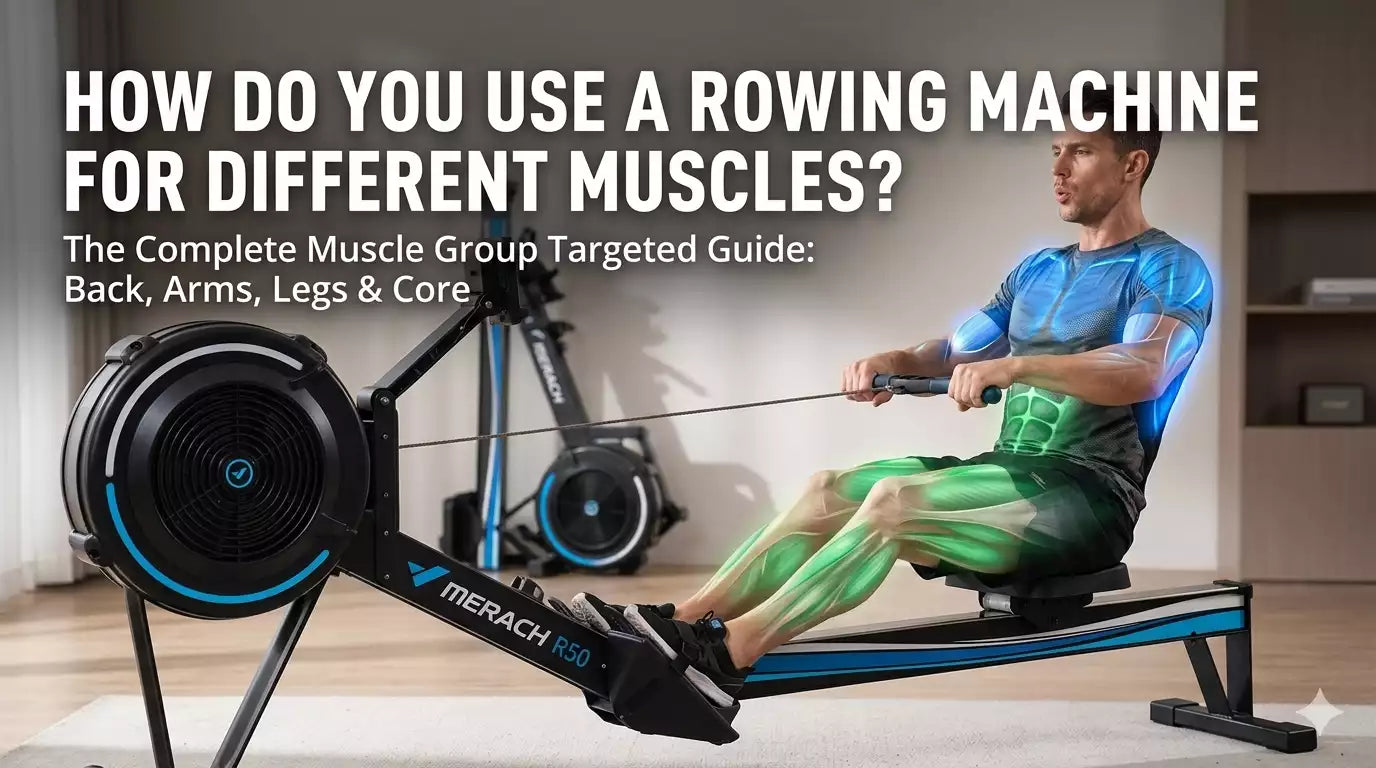
Rowing machines work around 86% of your body's muscles in a single stroke. That's more than most cardio equipment can claim. But here's what many people don't know: you can actually adjust how you row to put more focus on specific areas.
We're going to walk you through the mechanics of rowing for different muscle groups, so you can get more out of each workout. Whether you're trying to build stronger legs, a more defined back, or better core stability, the way you set up and execute your stroke makes all the difference.
Understanding the Four-Phase Rowing Stroke
Every rowing stroke breaks down into four distinct phases: the catch, the drive, the finish, and the recovery. Each phase activates different muscles, and understanding this sequence helps you know when and how each muscle group fires.
The catch is your starting position. You're compressed at the front of the machine with shins vertical and arms extended. Your hamstrings, calves, and core are engaged here, preparing for the explosive work ahead. Think of this as loading a spring.
During the drive, your legs push first while your arms stay straight. This is where 60% of your power comes from. Your quads, glutes, and hamstrings do the heavy lifting. Once your legs are nearly extended, your core and back swing into action, and finally your arms pull the handle to your chest. This sequence matters more than most people realize.
The finish happens when your legs are fully extended, you're leaning back slightly to about 1 o'clock, and the handle is at your lower ribs. Your biceps, lats, and shoulder muscles hold this position while your core stabilizes everything. The recovery reverses this sequence in slow motion, allowing you to return to the catch position with control.
Targeting Your Lower Body: Legs and Glutes
Your legs generate the majority of rowing power. We've tested the NovaRow R50 with adjustable resistance levels, and we've found that higher resistance settings between 7-10 really emphasize leg work.
To maximize lower body engagement, focus on a powerful leg drive at the catch. Push through your feet like you're doing a horizontal leg press. Keep your arms extended during this initial push so all the power comes from your quads, hamstrings, glutes, and calves. Don't let your arms bend early or you'll steal power from your legs.
Your glutes extend your hips and move your torso from forward to upright. Your quads straighten your knees with explosive force. Your hamstrings work during both the drive and recovery phases, flexing your knees as you slide forward again. Even your calves contribute by stabilizing your ankles and helping with the push-off.
For leg-focused rowing, try longer steady-state sessions at moderate stroke rates around 20-24 strokes per minute. This builds muscular endurance in your lower body without rushing through the motions. You'll feel the burn in your thighs and glutes after just a few minutes.
Building Your Back and Shoulders
Your back muscles get serious work during rowing, but only if your form is correct. The pulling phase activates your lats, rhomboids, traps, and rear deltoids. These are the muscles that create that V-shaped torso and support good posture.
To emphasize your back, make sure you're completing the full stroke. After your legs extend, your torso should swing back to that 1 o'clock position while your arms are still straight. Only then do you pull with your arms. This body swing is when your latissimus dorsi and erector spinae muscles fire hardest.
When you pull the handle toward your chest, focus on squeezing your shoulder blades together. This activates your rhomboids and traps more effectively. Your deltoids stabilize your shoulders throughout the entire stroke, helping control the movement and prevent injury.
The NovaRow R50's ergonomic design supports proper back positioning, which reduces strain on your lower back while still working those muscles. We recommend moderate resistance settings around 4-6 with higher stroke rates of 26-30 strokes per minute for back-focused work. This creates more frequent pulling motions that challenge your upper body.
Engaging Your Core Throughout the Stroke
Your core works constantly during rowing, but most people don't realize it. Your abdominals, obliques, and lower back muscles stabilize your spine and transfer power from your legs to your arms. Without a tight core, you lose efficiency and risk back pain.
Your abs act as stabilizers through the entire stroke. During the drive phase, they transfer power from your legs through your torso to your arms. At the finish, they support your backward lean and prevent excessive arching in your lower back. Your obliques keep your torso from rotating, maintaining that straight line of power.
To maximize core engagement, think about bracing your midsection like you're about to be punched. Keep this tension throughout the stroke. Don't collapse forward or lean back too far. The sweet spot is that controlled 1 o'clock finish position.
Your lower back muscles, specifically the erector spinae group, work with your abs to control your hip hinge. They stabilize your trunk during the drive and maintain your posture during the recovery. This dual action from front and back core muscles creates a stable platform for power transfer.
Working Your Arms and Grip
While your arms contribute only about 10% of rowing power, they still get a solid workout. Your biceps, triceps, and forearms all activate during different phases of the stroke. Strong arms help you maintain control and complete each stroke efficiently.
Your biceps engage during the drive and finish phases, flexing your elbows to pull the handle toward your sternum. But they shouldn't do this work until after your legs have pushed and your body has swung back. Pulling too early with your arms is one of the most common mistakes we see.
Your triceps work during the catch and recovery phases, extending your arms forward and maintaining control as you return to the starting position. They help you reach forward without collapsing your posture. Your forearms and grip muscles fire constantly, holding the handle throughout the stroke without excessive tension.
For arm-focused work on the NovaRow R50, ensure you're completing the full finish position and holding it briefly. This increases time under tension for your biceps. During recovery, control the handle extension with your triceps rather than just letting your arms flop forward.
Adjusting Resistance for Muscle Focus
The NovaRow R50 offers 10 adjustable resistance levels, giving you precise control over which muscles work harder. Higher resistance (levels 7-10) creates more demand on your legs and back, similar to lifting heavier weights. Lower resistance (levels 2-4) allows for faster stroke rates that emphasize cardiovascular fitness over pure strength.
For leg development, crank up the resistance and focus on explosive drives from the catch. You'll feel your quads and glutes working harder with each stroke. For back and arm work, moderate resistance with deliberate pulls and controlled recoveries hits those upper body muscles more effectively.
Air resistance systems like the one in the NovaRow R50 naturally increase resistance as you row faster, creating a smooth, responsive feel. This mimics actual water rowing where your effort directly correlates to resistance. The smart tracking features help you monitor your stroke rate and power output, so you can adjust your technique for specific muscle targeting.
Don't forget that resistance is just one variable. Your stroke rate, drive length, and form all interact to determine which muscles get emphasized. Play with different combinations to find what works best for your goals.
Common Form Mistakes That Reduce Muscle Activation
Poor technique doesn't just waste your time—it reduces muscle activation and increases injury risk. We see these mistakes constantly, and fixing them makes an immediate difference in workout quality.
Pulling with your arms first is the biggest error. Your legs are your largest, strongest muscle groups. When you yank with your arms before your legs finish extending, you're bypassing your most powerful muscles. Keep those arms straight until your legs are almost fully extended and your torso has started swinging back.
Rushing the recovery is another problem. The drive should be powerful and quick, but the recovery needs to be twice as long. This ratio allows for better muscle activation and prevents you from exhausting yourself too quickly. Control your return to the catch position.
Slouching forward collapses your chest and prevents full lat activation. Keep your chest up and shoulders relaxed throughout the stroke. Don't let fatigue pull you into poor posture. The ergonomic seat on the NovaRow R50 helps maintain proper positioning, but you still need to focus on form.
Gripping the handle too tightly fatigues your forearms unnecessarily and creates tension up your arms and shoulders. Hold firmly but not desperately. Your pinkies should be at the edges of the handle, thumbs wrapped underneath, with minimal palm contact.
Conclusion
Rowing machines deliver a full-body workout that few other cardio machines can match. By understanding how each phase of the stroke activates different muscle groups, you can adjust your technique to emphasize the areas you want to develop. Focus on powerful leg drives for lower body work, complete back swings for lat development, and constant core bracing for stability.
The NovaRow R50's adjustable resistance levels, ergonomic design, and smart tracking features make it easier to target specific muscles while maintaining proper form. Whether you're building strength, improving endurance, or just looking for an efficient workout, rowing works. Just remember that technique beats effort every time. Master the four-phase stroke, avoid common form mistakes, and adjust your resistance and stroke rate to match your goals.


Leave a comment
This site is protected by hCaptcha and the hCaptcha Privacy Policy and Terms of Service apply.